
Wisemindz Journey

When was the company founded?

24th August 2017.

What problem is it trying to solve in the education ecosystem? 

Students are lacking conceptual understanding in Computing and Literacy skills and they are moving out without any foundational skills required in real life

As per ASER Survey,

After five years of schooling, at age 10-11 years, just over half (51%) of students in India can read a grade II level text (appropriate for seven- to eight-year-olds). 

For computing ability just 28% of grade V students are able to do division, compared with 37% in 2008. 

Why did the founder feel the need to start this company? Any personal experience? 

While working in the K-12 domain and implementing integrated curriculum solution for over 10000 schools pan India, handling a team of 400 people, launching a books division as the President in one of the leading education companies, perceived the gap in knowledge dissemination in schools. Mr.Sachin Dhakate, CEO & Founder , realized that the activity-based learning was not really brought to be as age-appropriate content. Moreover, the activity-based programs were said to be time consuming, costly and diversion of the traditional learning practices. With a mission to change this belief, he zeroed in upon organizing experiential learning programs doing workshops in Mumbai, Indore and Nagpur. With his K-12 relations, Sachin got an opportunity to work with Vibgyor Group Bangalore, Poddar World School Group Mumbai. “During this period, we fine-tuned our programs, ran through the iterations and made it in curriculum ready. The programs of Abacus and Vedic Math have been moreover mishandled by half-baked trainers and net surfers making it more difficult for a child to learn. While speaking to over 2000 odd parents and more than 300 principals, we understood that the program has to focus on more intrinsic behavioral aspect of a child. For that it has to be part of a curriculum. We devised a platform that can be affordable to each child at a fraction of cost as compared to the existing market price. This is how we marked our beginning,” Sachin informs.

Through all its products, the company ensures that the child explores through hands on activity-based learning. It focuses on creative wisdom that accelerates holistic development, gives exposure to left brain and right brain activity from early childhood that brings the best out of the students. Through the programs, it aims to expose the child to the right learning environment so that effective learning happens in a fun way. They can learn skills in leadership, community involvement, communicating across different technology platforms, finding their passions, and teamwork, which will position them for success well beyond their school years.

What are the unique/key features which help solve the problem for your target audience?

With the simplistic approach in adopting the learning methodologies, there should not be any hindrances and barriers in one’s learning process. This forms the core of our product philosophy.

We believe that every child is born with equal ability. It’s the environment and experiential learning offered thereafter that makes a difference. Through our programs, we aim to expose the child to the right learning environment so that effective learning happens in a fun way.

At Wisemindz, we focus on creative wisdom that accelerates holistic development. We give exposure to left brain and right brain activity from early childhood that brings the best out of our students.  Every person has inherent traits that need to be explored for desired results. One of the tools that we use is based on the multiple intelligence theory proposed by Dr. Howard Gardner, a professor of cognition and education at the Harvard Graduate School of Education who developed his theory of multiple intelligences.

Name of the product/service, if any? What it does?

Product Details:
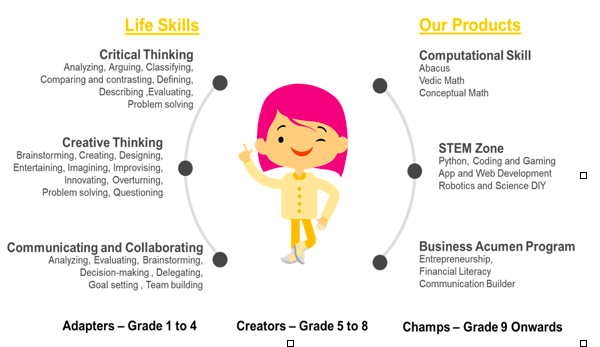
Computational Skills: Computational thinking helps students develop skills that are attractive for future employment opportunities. Math computation skills are usually introduced during the early elementary grades in the following order: addition, subtraction, multiplication and then division. Teachers often reinforce math computation skills via games, timed tests and drills. New learning builds upon prior knowledge and is continually dependent until students have mastered all four skills. We have 3 products under computational skills- Abacus, Vedic Maths and Conceptual Maths. 

STEM Zone: STEM is a curriculum based on the idea of educating students in four specific disciplines — science, technology, engineering and mathematics — in an interdisciplinary and applied approach. What separates STEM from the traditional science and math education is the blended learning environment and showing students how the scientific method can be applied to everyday life. It teaches students computational thinking and focuses on the real-world applications of problem solving. STEM includes following products

Business Acumen: This program entails business knowledge to students at an early age so that they can understand advanced concepts such as revenue or profit margin. The key is to start with the basics and incrementally work toward more difficult concepts. 

To learn more about our programs ,check out our gamified learning management platform : Wisemindz Programs

 

Read More

VISUAL MATHEMATICS : Beyond Curriculum Mathematics

It is imperative that mathematics is a real-life skill preposition that propagates the prophecy of learning beyond the classroom. Important life skills mathematics teaches are:

  • Every problem has a solution
  • Follow certain steps and be process-oriented
  • Detailing of data
  • Figure out a solution in the given data and constraint
  • Analytical mindset
  • Creativity through numbers and many more

If you truly try to mull over, one may think that critical skills and real-life application are the way forward. Some of the rudimentary formulae can literally shape up the way we look at the solutions to the problems faced in real life. Sir Srinivasa Ramanujan has aptly said, “An equation is nothing to me unless it expresses the thought of God”. Comprehending the problem statement is equally important in solving mathematics. One has to speak and understand the language of maths.

What is the mathematics language?

One has to understand the language and the sound that mathematics helps to evolve. The child starts learning things by sensory organs touch and feel, smell, seeing and sound then get introduced to patterns, groups and finally introduction to alphabets and numbers. However, there is limited exposure to develop these sensory organs as we go higher up in the formal school environment.

How do we develop computing skills and make justice to the overall brain development?

Let us first understand what is overall brain development? We need to exercise both the hemispheres of the brain. The left part is the logical, calculative, storing numbers mind while the right part is storing visuals, sound clips, and videos often referred to as creative mind. Visualizing a math problem helps in nurturing the brain. Children at a young age have exceptional ability to take the learning ahead if they are exposed to the right kind of learning platform so that they can use this for development which is otherwise not often utilized up to the fullest extent. Calculating and computing skills developed at early ages help gain the confidence and brain capacity building that stays for a lifetime.

How do computing programs help in development?

The coming generation is thinkers and students who are exposed to early childhood development programs will definitely have an edge over others. Programs like Abacus that talk about the development of computing through visualisation. It helps in integrating the conceptual understanding of the left as well as right-brain thereby forming creative wisdom. For them, the processing of information is not only about math but also encompasses other subjects. Creative stimulation is very much needed. This helps the students to outperform their peers. Reliability on gadgets becomes less and the child takes interest in doing arithmetic of up to 10 digits or more calculations. Ability to focus and concentrate, intuitive thinking, understanding place value with formulae and application of concepts in real life helps the child’s overall development. The learning starts from an early age of 4 years and can go up to 13 years. The children start with basic counting, understanding the structure, hand and finger movement and then apply the concept and formulae for addition, subtraction, multiplication, and division. Once the students get acquainted with the basic concepts of understanding numbers then they practice oral calculations and do tables of more than 2 digits orally faster than the electronic device. Students understand the compliments method of 10 and 5 for example 10 = 6 + 4 = 7 + 3 and so on and 5 = 4 + 1 = 3 + 2 and so on. With this compliment technique, they understand the simple arithmetic operation and apply it to more complex calculations and improve their computing skills mentally. There is anxiety for not performing in math which is reduced by practicing calculations on Abacus. The exercises comprising flash-cards, video clips, and auditory questions help stimulate the right kind of sensory organs for overall brain development.

When the children grow up and reach 11 years they should be embraced with higher-order thinking skills and exposed to even larger computing skills. They should understand the meaning of comprehension and problem solving and how these computing skills are applied in the curriculum. The concepts of Vedic Math help children to go beyond mathematics and open a whole new world of math-e-magic. The Vedic Math is based on the 16 sutras (formulae) derived from the Vedas by Shri Bharti Krishna Tirthaji. This comprehension has given a whole new dimension in understanding the calculation concepts. By exploring these formulae and applying more iteration on them, a whole new computing technique can be derived. Whether it’s a 2 digit by 2 digit or 3 digits by 3 digits multiplication or finding the square of a 5 digit number can be as simple as writing A to Z. The interesting part is how it is applied in the curriculum as there are misconceptions that with Vedic Math the students pay less attention to the steps and focus more on answers. Therefore, proper guidance is needed for students in applying the Vedic Math calculation principles. When children embrace higher – order thinking skills, they see a whole new world with confidence and a sense of achievement, gaining the ability to perform boosts their results in improving their Study Quotient. They find creative ways of number crunching and intelligent ways of arriving at the answers which help them to crack competitive exams.

If the techniques of Abacus and Vedic Math are coupled with a conceptual curriculum of math it will do wonders for the students. Today is the world of engagement through inclusive participation as well as immersive content. Keeping that in mind, if the students get that experience of visual mathematics coupled with gamified content and assessments then it’s a real treat to watch how the brain development shapes the new generation. This shall create a society of future thinkers. As Pythagoras has aptly said “Number was the substance of all things”, let us decode these numbers and help improve computing skills.

Sachin Dhakate, Co-founder Wisemindz Ventures Pvt. Ltd.

BE, PGDM IIM Lucknow, and 20+ years in teaching, Edtech, and Corporate.

Wisemindz is an activity-based experiential learning platform that nurtures students’ life skills right from pre-primary level through various mediums of Coding, Computing, Communication, and Business acumen skills.

Read More

Wisemindz Joins the Amazon’s AWS Edstart Program

It is a privilege to let know that Wisemindz Ventures has been selected to join Amazon’s AWS EdStart Program. AWS EdStart is a program designed to help innovative companies build the next generation of online learning, analytics, and education management solutions, incorporating cloud technologies.

“The Speed math and STEM platform in schools has helped the students to garner the required skills” says Mr. Nishikant from Hunslow, UK. One of the Director Mr. Sharad Gandhi says “The Coding and Robotics lab in the school as given exposure to students on practical learning”.

One year down the line the usage and implementation using the AWS cloud will give a different user experience in the experiential learning domain for schools. Moreover the individual students will be able to check on their life skills assessment on real time basis. Wisemindz will start Leap platform to get the learning coupled with simulation and data sets on the cloud, making it efficient for the learner to achieve the required skill sets. The platform will include Machine Learning and AI based assessments along with personalised content.

“The AWS Edstart program selection has elated the team and given boosts to the confidence and is an exciting achievement for the team Wisemindz. We see as a great value addition in the selection and our strategy focus on future investments” said Sachin Dhakate, Cofounder Wisemindz. “AWS is our strategic and critical component in the service offering that shall create a differentiating factor in the user experience. The cloud technology and support from AWS will mark a new era of growth for the company. Membership in the EdStart program provides access to training, mentoring, marketing and other support from Amazon that aims to create niche and accelerate growth”

“AWS Edstart members are transforming the education landscape across the globe. Thank you for being an active member of the AWS EdStart Community! Our team has identified your company as influential in revolutionizing education” – Team AWS

About Wisemindz:

Wisemindz Ventures Private Limited – An IIM Alumni initiative is founded in 2017 by education industry professionals and IIM alumni along with IT education experts having a combined experience of 50+ man-years in various domains of education. The philosophy of the company is to provide cost effective experiential activity based learning programs to the Schools and various independent Institutes. The focus is to develop and nurture intellectual capability since early childhood through experiential learning programs.

At Wisemindz, we focus on creative wisdom that accelerates holistic development. We give exposure to left brain and right brain activity from early childhood that brings the best out of our students.  Every person has inherent traits that need to be explored for desired results. One of the tools that we use is based on the multiple intelligence theory proposed by Dr. Howard Gardner, a professor of cognition and education at the Harvard Graduate School of Education who developed his theory of multiple intelligences.

Wisemindz has customer base present in India, UAE, UK

  • We set up a STEM zone in the curriculum program model.
  • In the Technology front we set up the –Coding, Robotics, Financial Literacy, Entrepreneurship and Employable Skills from class 1 to 12.
  • Science DIY program for class 1 to 9.
  • For Math we set in house developed Abacus (Class KG2 to 5th) and Vedic Math (Class 5th Onwards) zones for brain exercise and faster calculations.
  • Live classroom platform
  • We do Career Counseling of students from class 7 onwards up to Postgraduate through artificial intelligence based Online Psychometric testing

For more details visit; www.wisemindz.com.

Read More

The Right And Left Brain

If we go by the medical terms, the brain can be defined as an organ of soft nervous tissue contained in the skull of vertebrates, functioning as the coordinating center of sensation and intellectual and nervous activity. But here are some more vital pieces to understand the brain than just its biological definition. The brain is divided into two parts – The right and the left part. You must have come across some articles or books that have guidelines to improve your creativity and logical thinking. What they are suggesting you is, to work on your right and left brain. People are often described as left-brain thinkers having a strong math and logic skills while the right-brain thinkers are more creative. But, did you know the growth of the right and left brain does not take place simultaneously. When a child is in his growing years mostly in the age group of 3-4 years, it is then the right brain develops. The left part of the brain develops mostly after the child has crossed his 7 years of age. The early years of the child are hence crucial for their development. Now, let us decode the functionalities of the two parts of the brain in details. Let us begin with the right part. Each side of the brain controls different types of thinking. The right part is more a kind of open playground. The unstructured play of imagination, expression and emotional intelligence is all permitted on the right part of the brain. We can even say that the right brain connects us to our infinite sense of being. The left side of the brain is considered to take up activities that involve logic, language, and analytical thinking. The left brain is far more interested in doing. In a nutshell, the left side of the brain tends to control many aspects of language and logic, while the right side tends to handle spatial information and visual comprehension. Hence when we are aiming at the progress of the child, we need to consider the development of both the right and left part of the brain. One needs to take up experiential learning that will simultaneously discipline your right and left-brain hemisphere. Experiential learning is an ancient method followed across the different parts of the world. While some used beads as in ABACUS, we Indians had Vedic Math, based on the 16 sutras. In the modern age, we have streams like Robotics and Practical Sciences that can be considered as a part of experiential learning. Experiential learning is the process of learning through experience, and is more specifically defined as “learning through reflection on doing”. Since Experiential learning is not confined to theory, the process has proven to have significant teaching advantages. A learner is benefitted through the education only if he can put a share of that knowledge to use in his future life which he gains from his desire to absorb the knowledge. In the subsequent blogs, we will learn more about the Experiential learning and knowledge about the streams that come under Experiential learning and their respective advantages.

Read More

Holistic Approach – Learning Introspection

It has been decades where the buzzword on the holistic approach is used and abused with much fanfare. However what the intent of the usage of the word and the actual usage is very satirical. It looks like most of the educators have taken a sabbatical and looking forward to each other to take the first step. The more egalitarian usage that we see in today’s education system especially in the K-12 segment, the whole lot is confused out there. The maze that the so-called humans have created has become educational and occupational hazards in the Child’s growth.

What is a holistic approach?

The purpose of education is to build a happier society; we need a more holistic approach that promotes the practice of love and compassion – The Dalai Lama

How I as an educator engage the student completely. The human being is a natural thinker and has conceptual building platforms that propagate in multi-direction. Am I as a teacher, as a mentor facilitating enough to raise the participation of an individual with or without a team and guide the participation physically, emotionally, mentally and spiritually?

I as an educator have to inculcate the habit of exercising the mind and body. Physical endurance is an important parameter to lead a sustainable life forward. The mind plays an important role. It knows the things that we like – to accept and the things that we dislike – to reject. It is the Yin and Yang in the mind that truly identifies with the theory of acceptance of selective wisdom. As an educator, I have to remove the blocks formed in the minds of my students.

In my interactions with various mentors, teachers, educators over a decade I have observed that somewhere people are caught in the dichotomy of knowledge dissemination and syllabus completion. As a teacher, I need to be facilitated as well. If I have to take a holistic perspective then my suggestions should be heard. Holistic approach is not about only making the student’s techno geeks, hands-on learning activity experts and wizards. The onus on the education system is to help them acquire enough skills so that they can build upon a sustainable career over a period of time. In my interview with 200 Principals, only 2 Principals have taken the session on the importance of nutritional value that to once in 6 months. However, some have made charts on what to bring in the lunch box.

Teach them the values and life skills that will make them better human being. Ironically we see that the life skills session is narrated, mind well I am using the word narrated and not taken as participative, once in a fortnight or a month. The physical education session is hardly there. Even if it is there the part-timers are there to operate. So clean that mess created by our inhibitions, shrug them and stride ahead. The small differences that we make in each other’s life carry a long way and inculcate the pride of developing the roundabout personality in a true – Holistic Approach

Read More